

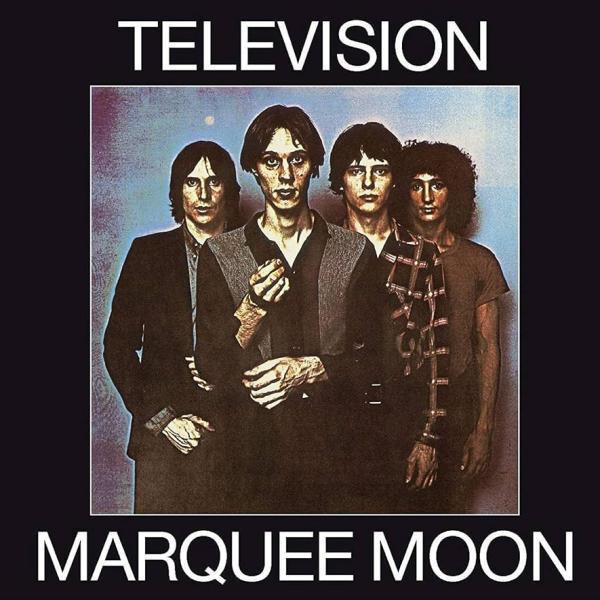
Television: Marquee Moon
Album #227 - February 1977
Episode date - June 17, 2026

As 1977 began, somebody hit the reset button. Nobody knows exactly who did it, or even where, but all over the Western world, the music scene changed suddenly, and dramatically.
For alternative music, 1977 was ‘year 0’. It was like every major musical scene erupted simultaneously. Albums previously seen as anomalies in 1976 came to be embraced by some as a means to challenge the mainstream. Debut albums by the Ramones and Patti Smith were dismissed, and in many cases outright scorned, by mainstream media, but a significant segment of the population found inspiration in the directness of their message. This music was not elitist. You didn’t need to be a technical wizard to play it, and you didn’t need a graduate’s degree to appreciate it.
While ‘mainstream’ music continually aimed over the heads of their target audience, this new style aimed straight for the torso. Just like Mitch Miller and Columbia Records did back in the ‘50s, the generation of anti-establishment hippies had grown old enough to erect a new establishment of their own, and they wanted to stick with what they knew. The blunt fashion and energy of the new style directly challenged everything that came before it, including the hippie ethos of pastoral love and brotherhood. The new sound was loud, urban, primal and rude. Somebody coined the term ‘punk rock’ and it stuck. Suddenly, the culture of previous generations was rendered obsolete.
New bands shunned the accepted commercial norm, and vice-versa. The ultimate irony came when hippies entrenched themselves and grew conservative, unable to accept punk music in any shape or form. Commercial radio wouldn’t play it and even the charts skewed ratings to disenfranchise punk bands. By definition, then, a nearly universal ‘alternative’ culture formed, centered in capital cities from London, England to Sydney, Australia.
In New York, the downtown scene previously represented by Max’s Kansas City and The Velvet Underground had moved south to the Bowery. Tom Verlaine, Television’s primary songwriter and vocalist, convinced club owner Hilly Krystal that his venue would be better suited for punk rock than ‘Country/Bluegrass and Blues’ and almost overnight, a trend became a scene.
CBGB’s was almost like a foster parent, taking in bands that were rejected elsewhere, and the scene grew exponentially, but if you lived outside of New York City, it would have been very easy to miss the relevance of what was happening. Discerning fans had to seek out information on the band (and the scene at CBGB’s) through fanzines and music reviews. It was Television, then featuring Richard Hell as their vocalist, who inspired Malcolm McLaren to return to England and form the Sex Pistols.
In some ways, “Marquee Moon” is almost conventional guitar-based rock music that seems unlikely to have caused much of a backlash. If heard with an open mind, rock fans might have recognized that “Marquee Moon” contained some of the best dual guitar work since the Allman Brothers, but those fans were set in their ways. Verlaine’s voice betrayed his lack of blues influences and had a timbre that resembled Patti Smith, so fans of rock music turned away, which was a shame. Television was a perfect introduction to punk rock, specifically because they did not lean heavily on the safety pin and torn t-shirt styles introduced by Richard Hell. Verlaine and Richard Lloyd played together seamlessly, weaving angular harmony lines over artful lyrics that didn’t rely on volume, screams or confrontation for impact.
The songs were thoughtful and original, with little or no reliance on blues formulas, exoticism or excess production. In that sense, “Marquee Moon” was a post-punk album even before punk had properly established itself. Although most critics raved, praising the album for the fresh, exciting and innovative classic that it was, the album failed to sell in America, but became something of a surprise hit in Great Britain, where punk had been sensationalized by the British press. Almost instantly, a new alternative underground scene had been born.
Featured Tracks:
See No Evil
Venus
Friction
Marquee Moon
Elevation
Guiding Light
Prove It
Torn Curtain
February 1977 – Billboard Did Not Chart
Related Shows