

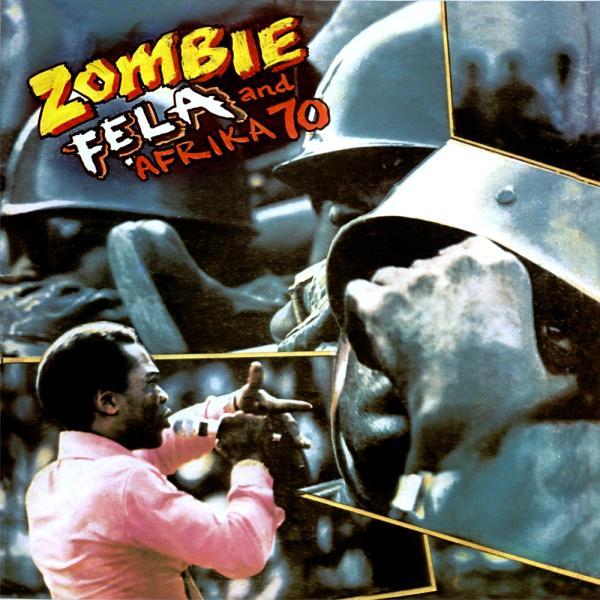
Fela Kuti: Zombie
Album #226 - December 1976
Episode date - May 20, 2026

Sorting through the discography of Fela Anikulapo-Kuti is an intimidating and overwhelming task, but fun as hell, and politically challenging.
With literally hundreds of releases, most of them poorly documented, it’s almost impossible to determine the best place to dive in. Even websites dedicated to such things are woefully incomplete and inaccurate. The ‘AllMusic’ website rates over twenty of his original releases as seminal, so if ever an artist needed to be represented by a well-annotated collection, it’s Fela Kuti.
There are at least two ways to appreciate the work of Fela Kuti. From a musical perspective, he plays some of the slinkiest jazz-based afro-groove you could ever hope to hear. Then, when he finally starts to sing (he usually takes his time letting the rhythm build up and sink in before unfolding his tale), a whole new perspective arises.
Fela Kuti used his power as a popular African musician to make bold political statements, usually aimed at a corrupt and westernized political system as hell-bent on keeping him quiet as he was on exposing their corruption and stupidity. For the decade from 1971 until 1981, he released records at the prolific rate of approximately three per year, most of them short enough to be labeled as EP’s rather than albums.
You don’t need to be Nigerian to appreciate the political views expressed by Fela Kuti. Americans can rightly be very proud of the freedoms we enjoy, but if we are honest we must admit that our own system is far from perfect, especially with regard to minorities. Just days before writing this, I heard a harrowing story of a 16 year old boy who was wrongly arrested, and sat in a high security prison for three years – two of them in solitary confinement – while he awaited a trial. Unfortunately, such things in our own culture are not as rare as we would like to think they are. In Nigeria, though, things are infinitely worse.
I ultimately chose “Zombie” as the best point of entry into Kuti’s catalog because it is the album that best represents the power, the cause, and sadly, the effect, that his music had in the political climate of its time. With just a few words, Kuti manages to incense the entire military community of Nigeria. Without ever stating anything explicit, it was apparent enough to the powers at hand that he was addressing his outrage at them when he sang “Zombie no go think, unless you tell him to think…Tell him to go kill, no break, no job, no sense”, then “Go and kill! Go and die!” Sickeningly, the ‘zombies’ then behaved exactly as he portrayed them.
Soon after this track was released, the army descended on Kuti’s commune, beating Kuti to a pulp and throwing his own mother to her death from an upper window, then burning his building to the ground. After recovering from his injuries, Kuti responded to the attack by releasing “Coffin for Head of State” as a sad memorial for his mother’s fate. His career remained politically motivated for the rest of his life and there is hardly a release that is not powerful in its own way. If you like what you hear, there’s a whole lot more to discover. There is no American equivalent.
Featured Tracks:
Original LP
Zombie
Mister Follow Follow
CD Re-issue Bonus Track
Observation Is No Crime
December 1976 – Billboard Did Not Chart
Related Shows