

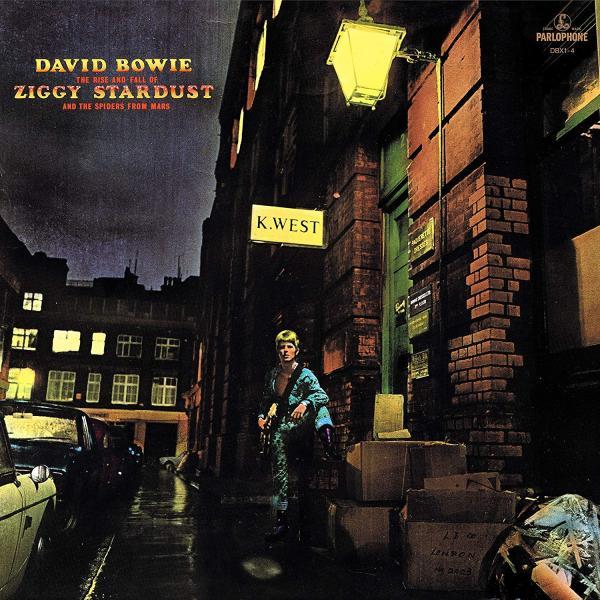
David Bowie: The Rise and Fall of Ziggy Stardust and the Spiders from Mars
Album #153 - June 1972
Episode date - June 2, 2021

The best characteristic about Ziggy Stardust and the Spiders From Mars is also its major weakness, which is Bowie’s innate talent at knowing his audience.
There was a generation of kids In England who were waiting, practically frothing at the mouth, for something as liberating and exciting as this Ziggy Stardust character to come along. At a time when rock and roll music was mostly comprised of sensitive singer/songwriters and instrumental technicians, David Bowie provided a breath of fresh air, and liberated a generation whose turn it was to rebel. It was beautiful on those terms, almost perfect. But like I said, its best feature is also a glaring fault. By appealing so grandly to contemporary youth, it meant that Bowie’s ‘Stardust’ character was doomed to become little more than a charming memory. He’s so damned accurate in capturing the shock appeal of an early ‘70s teenager’s aspirations that the record sounds a bit juvenile now.
Bowie spoke the language of Britain’s youth and turned himself into a figurehead for what would be called the ‘Glam’ movement. Bowie created something both cool and liberating; he made music with a purpose, or at least what seemed purposeful to kids in their early teens. Ziggy was an exciting character, and his outrageousness offered up an entire universe of possibilities. Mostly, he offered us a new form of rebellion, a strange one, but it was ours, and we loved it. The song “Star” spelled out the most enticing possibility of all, which was to invent yourself (as Bowie did) as a genuine rock and roll star. That, in effect, is the underlying theme that stitches the album together. Bowie uses the word ‘star’ in no less than four song titles! For teenagers trying to eke out their own identity, few things held more allure.
The album begins and ends with its most dramatic material; “Five Years,” about the impending end of the world, and “Rock and Roll Suicide”, which is fairly self-explanatory. Both parlayed a youthful tendency toward the dramatic and added an artistic flair into the equation, which virtually guaranteed their success. At first, a large segment of the American audience dismissed it all as androgynous melodrama, or a freakish threat to normalcy. It’s a rare thing for a superstar’s acknowledged best album to miss the top 40, but David Bowie’s first masterwork stalled in America at #75. America simply wasn’t ready for something as freaky as this, But England sure was. Ultimately, Bowie’s vision became more and more acceptable and mainstream, especially with the onset of punk, which made ‘glam’ seem almost safe in comparison, but at the time, there was nothing like it. “Ziggy Stardust”, “Hang On To Yourself” and “Suffragette City” were all anthems, and any real appreciation for this record must take into account the social zeitgeist of the time in which it was created. Ziggy Stardust is frozen in that time and he reminds us of what it was like to really feel alive in 1972.
June 1972 - Billboard Charted #75
Related Shows