

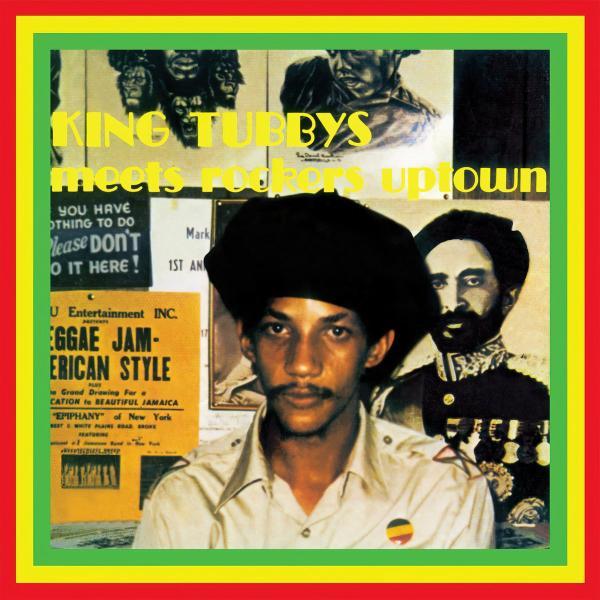
Augustus Pablo: King Tubbys Meets Rockers Uptown
Album #225 - December 1976
Episode date - May 13, 2026

By the time “King Tubbys Meet Rockers Uptown” was released, Jamaica already had an extraordinarily rich history of altering pre-established recordings.
The island’s indigenous music scene was based almost exclusively on non-indigenous sources, mostly rare instrumental tracks from various parts of the southern United States. Deejays would ‘boast and toast’ over their found treasures from sound system trucks, creating an atmosphere that would convert neighborhoods into spontaneous outdoor block parties.
As time wore on and studios grew more sophisticated, the same basic methodology applied, but now the singing Deejays gave way to producers playing with multi-track recordings. Four-track and eight –track recording became commonplace in the late sixties, and recording engineers used the technology to record bandmembers separately, then ‘layer’ the various sounds together in a process known as mixing, while ‘dubbing’ in background vocals and/or other studio professionals to fix any perceived shortcomings. To this day, it’s still done pretty much the same way, even for ‘homemade’ recordings, except that nowadays most producers work with a minimum of 24 tracks.
With a history based on sound alteration, Jamaicans discovered an entirely different use for multi-track recordings. Rather than simply ‘mix’ the sounds together in a conventional manner, they manipulated the faders, added processing, and played with playback speeds until the basic track was barely recognizable. The technology allowed them to eliminate vocals, cross-fade various instruments, fading them in and out, while applying sound effects like a French chef adds butter. In a stroke of genius literalism, Jamaicans called their process ‘dub’.
Dub actually means a lot of things in Jamaican culture. Some people note that the word is derivative from ‘duppy,’ which means ghosts – or more, specifically, the ghosts of those killed from the racial violence of colonialism, with echoes representing disembodied voices and sudden sounds representing the harsh fate that befell the native culture. That is a romantic notion, but it is more likely that the word derived from ‘doubling’, or creating a modified version of an existing track.
In ‘dub’, the tracks are often stripped of all ornamentation, leaving drums and bass as the primary characteristic of the recording, then adding slap-back echo, while fading in random bits of the original track, giving each ‘version’ a spiritual life of its own. Regardless of the technicalities, it is no small matter that dub came to fruition in Jamaica, a country that revered marijuana and through Rastafari, had even elevated it to a sacrament. Imagine being high out of your mind and hearing these ganja-induced mixes for the first time, on a superb stereo sound system. Americans need to relate. In other words, if you got ‘em, smoke ‘em.
King Tubby and Lee ‘Scratch’ Perry were among the first experimenters in dub technique, randomly interchanging instrumental and vocal mixes, then altering the ‘riddim’ until something entirely new resulted. The results were fantastical, almost psychedelic, and incredibly versatile, leaving space for deejays to add their own vocals on a whim. Meanwhile, Augustus Pablo followed a similar path, creating the ‘Rockers’ record label for his own recordings, usually featuring him playing the melodica, a simple instrument often used by children to learn music notation. Pablo worked with some of Jamaica’s finest musicians, so his teaming with King Tubby was as inevitable as it was fortuitous.
As the career of Lee ‘Scratch’ Perry can attest, there is little about the history of dub that is linear, but “King Tubbys Meet Rockers Uptown” is about as close as we can get to an actual document that captures the Wild West spirit of Jamaican dub music. Perry may have been there first – his “Blackboard Jungle” album was released three years earlier – but distribution for that record was limited to only 300 copies, and has been relentlessly re-released, with alternate versions that bear little resemblance to one another. Augustus Pablo had a larger commercial following, and his “King Tubby” release marks a point where dub became legitimized as an art form in itself. As befits the style, this album also exists in a variety of versions with different covers and song arrangements. It is difficult to determine which ‘version’ is truly definitive, but in the land of dub, confusion makes much more sense than linear logic.
Feature Tracks:
Keep On Dubbing
Stop Them Jah
Young Generation Dub
Each One Dub
555 Dub Street
Braces Tower Dub
King Tubby Meets Rockers Uptown
Corner Crew Dub
Say So
Skanking Dub
Frozen Dub
Satta Dub
December 1976 - Billboard Did Not Chart
Related Shows